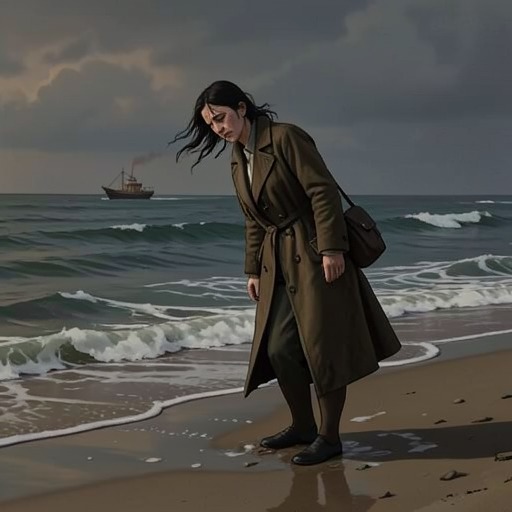
Zebra
Life of PiThe Zebra is a male Grant’s zebra whose passage from the Pondicherry Zoo to a storm-tossed lifeboat turns an admired animal into one of the most vulnerable figures in Pi Patel’s shipwreck account. First encountered as a creature of striking pattern and calm appetite, it becomes trapped beside predators and an injured human castaway; in the later account without animals, its story is recast as that of the Taiwanese sailor.
Identity and Introduction
At the Pondicherry Zoo, Pi introduces visitors to a zebra unfamiliar to them. One Mr. Kumar, a teacher, is astonished by its stripes and asks whether they have been painted on and whether rain could wash them away. Pi explains that the pattern is natural and identifies the animal as belonging to the same family as the ass and the horse. He gives its more specific classification as a Grant’s zebra, Equus burchelli boehmi.
The introduction unfolds through a small act of feeding. Pi has brought carrots, and when the zebra approaches the low fence, he divides the last large carrot between the two visitors, both addressed as Mr. Kumar. The teacher offers his piece first; the zebra takes it eagerly, while the baker lets go of his share more readily. Their delight is different but complementary: one is impressed by the animal’s physical presence, the other calls it a wondrous creature. Their responses frame the Zebra as an object of both ordinary contact and intellectual curiosity, a living animal whose familiar relation to horses and asses does not diminish its strangeness.
From Zoo Animal to Displaced Cargo
The Zebra belongs to the world of the Pondicherry Zoo that Pi’s family must dismantle when they decide to emigrate to Canada. The zoo is sold as a whole, and its animals are distributed among buyers, mainly zoos in the United States. The arrangement is shaped by money and regulation: American institutions are willing to pay more than Indian zoos, while the new restrictions associated with the Convention on International Trade in Endangered Species make the future of captured wild animals increasingly dependent on transfers between zoos.
Moving the collection proves far more complicated than simply finding buyers. The process requires negotiations, health and origin certificates, export and import permits, quarantine decisions, and transportation plans. The narrative emphasizes the contrast between the animals’ physical presence and their transformation into objects of paperwork and international exchange. Zebras are among the animals in demand, but the account does not identify the Zebra’s individual destination. It establishes instead the institutional circumstances that place the zoo’s animals in transit before the family boards the Tsimtsum.
Arrival in the Lifeboat
After the Tsimtsum sinks, the ship’s crew throws Pi overboard toward a lifeboat. A male Grant’s zebra follows, missing the tarpaulin and landing heavily on the boat’s last bench. The impact breaks the bench and shakes the craft before it drops into the water. Pi, who has landed on the tarpaulin, survives the fall; the Zebra is left badly hurt near the stern.
At first, Pi assumes that the Zebra should already have been killed by the tiger Richard Parker. Its survival leads him to infer that the tiger is no longer aboard. He then discovers that a spotted hyena is in the boat. The Zebra’s presence has thus altered the immediate arrangement of danger: it is an injured animal sharing confined space with a predator, while Pi is himself exposed and trying to understand what has happened. The crew’s apparent rescue of Pi is also reinterpreted. Pi concludes that they used him as a possible distraction for the hyena rather than acting primarily to save him.
Suffering, Attention, and Loss
In the morning, Pi’s attention is initially fixed on the horizon and imagined rescue. He pictures a reunion with his family before looking back into the boat and seeing that the hyena has attacked the Zebra. Its already injured leg is gone, and Pi feels horror and anger toward the hyena. Yet his response quickly gives way to the immediate pressure of his own survival. He admits that he cannot sustain pity for long, although the Zebra’s suffering remains in his memory and in his prayers.
The violence escalates later, when the hyena attacks again. The Zebra struggles to defend itself but is unable to escape. Pi witnesses the assault without being able to intervene. The next day the Zebra is still alive, despite the severity of its condition, and dies by noon. Its drawn-out decline makes the boat’s danger more than a single sudden disaster: Pi is forced to remain near a suffering animal while his own strength and safety are precarious. The scene also registers a limit in the human observer. Pi notices the Zebra’s distress, condemns the hyena, and grieves, but survival repeatedly narrows what he can do and how long he can attend to another creature.
Counterpart in the Human Account
When Pi later tells a version of the shipwreck without animals, investigators Tomohiro Okamoto and Atsuro Chiba compare the two narratives. Okamoto notices that both the Zebra and the Taiwanese sailor break a leg. He also connects the Zebra’s lost leg with the sailor’s amputation by the cook. These correspondences lead him to identify the Zebra as the animal counterpart of the sailor.
That reading changes the Zebra’s place in the book without erasing its animal story. In the lifeboat account, it is a particular animal: a Grant’s zebra from a zoo, carried into the storm, badly injured in its landing, attacked, and dead by the following day. In the human account, its injuries and helplessness correspond to the sailor’s experience under the cook’s control. The parallel is established through matching events rather than through an explicit equivalence within the original lifeboat scene. As a result, the Zebra links the two accounts while preserving the disturbing difference between how each version makes suffering visible.